
You’re watching your baby and wondering: Is this normal? Are they where they should be? Why isn’t my kid doing what the other babies are doing? I get asked these questions constantly.
New parents are naturally watching their babies like hawks and comparing them to every other kid they see. Here’s what I want you to know upfront: babies develop at different paces, and that’s completely okay. The milestones I’m about to share are guidelines, not rigid deadlines. That said, I hope that understanding what’s developmentally “typical” gives you a roadmap and peace of mind.
Let me walk you through what infant motor development actually looks like, month by month, from that itty-bitty 3-month-old to your 2-year-old who’s somehow already running away from you.
Months 3–4: The Beginning of Head Control and Reaching
When your baby hits 3 months, they’re starting to pay attention to the world. Their vision is improving (they’re starting to see more than just black and white), and their body is becoming more coordinated.
What to expect at 3 months:
Gross motor: Your baby should be able to lift their head during tummy time for 3-5 seconds and should be able to hold their head in the center of their body while lying on their back. They’re also starting to bring their hands to the middle of their body, this is called midline awareness and it’s foundational for all the other milestones.
Fine motor: Hands come to mouth and hands are starting to open and stretch out.
The reality: Some babies are lifting their heads like champs at 3 months. Others need a few more weeks. If your baby is resisting tummy time, that’s totally okay. Start with short bursts and make it fun! Put toys in front of them, get down on the floor with them, or make silly faces.
What to expect at 4 months:
This is where things get more interesting. Your baby is becoming more deliberate with their movements.
Gross motor: If your baby was struggling with tummy time, this is often the month where things click. They’re leaning on their elbows, which means they can lift their head higher and look around more. They might also start touching their hands to their feet when lying on their back.
Fine motor: Reaching becomes intentional. They’ll swing at toys (sometimes actually grabbing them), and they’ll start to use their palms to hold objects when you hand them things. Everything still goes to their mouths – this is how they learn about things!
Cognitive: Games like peek-a-boo start making sense, they recognize their favorite toys, and they turn toward loud noises.
Pro tip for tummy time resistance: If tummy time still seems hard for them, roll up a small towel and place it under their chest. This gives them a boost to lift their big heads up and makes exploring their environment feel easier.
Months 5–6: Rolling and Sitting Practice Begins
This is when development starts accelerating. Suddenly your baby is moving and you’re wondering how it happened so fast.
What to expect at 5 months:
Gross motor: Your baby is now pushing up into straight arms during tummy time. They’re also starting to roll from tummy to back – it might look clumsy or incomplete at first, but they’re figuring it out.
Fine motor: Their reaching is getting more accurate and they start raking at objects with their hands (raking looks like a slightly open fist where they grab whatever little objects they can – it’s not super coordinated yet, which is totally normal and expected).
Cognitive: Vision is sharpening – they’re starting to see granularity and color.
What to expect at 6 months:
Gross motor: Back-to-tummy rolling is beginning and sitting with hand propping (tripod sitting) is emerging.
Fine motor: They will start transferring objects between their hands as well as shake and bang their toys. They’re also learning to hold objects between their thumb and palm (early pincer grasp).
Cognitive: Babbling begins! Your baby might laugh. They often enjoy pop-up toys and are starting to connect cause and effect.
The milestone to watch: If your baby isn’t rolling in all directions by 6 months, that’s something to mention to your pediatrician.
Months 7–9: Independence Emerges
Around this point, you’ll notice your baby is becoming way more independent. They want to explore, they’re getting stronger, and they’re moving in ways that require you to babyproof literally everything!
What to expect at 7 months:
Gross motor: They are either sitting independently while holding toys or they’re still using hand propping, but gaining confidence. They are also starting to use their hands reflexively to catch themselves if they fall to the side.
Fine motor: Their grasping is becoming more precise and their reaching is more accurate.
Cognitive: They recognize animals, shapes, and faces. They’re understanding that if they drop something, you’ll pick it up (the start of object permanence). Oh yea, and they start making the cutest babbling noises ever!
Pro tip: Don’t just plop your baby in a sitting position. Let them roll, squirm, and maneuver into it themselves. This teaches them how to do it next time.
What to expect at 8 months:
Gross motor: They are figuring out how to get to and from sitting and lying down more easily. Army crawling begins around this age, but it’s messy and yes, they may get carpet burn on their belly.
Fine motor: They’re holding a bottle independently and holding small toys with one hand.
Cognitive: They understand games like peek-a-boo deeply now and they remember how to play with toys from one day to the next. This is all because their understanding of object permanence is solidifying.
What to expect at 9 months:
Gross motor: “Pull to stand” is starting: your baby is using furniture or your hands to pull themselves up and then they cruise (walk sideways while holding furniture) once they get into standing. Crawling with reciprocal leg and arm movement is either happening or emerging, but this is a tricky skill and don’t be alarmed if they are still commando crawling.
Fine motor: Their pincer grasp is improving, which allows for mature “finger feeding” like picking up a cheerio. They’re also learning to open their hands based on the size of the object they’re reaching for.
Cognitive: They may begin to point, wave, blow kisses, and clap. They might even throw small objects (this one is super fun!).
The fact people don’t talk about: Crawling was actually removed from the CDC developmental milestone list, but it’s so important. It builds shoulder and hip strength, improves depth perception, and gives your baby independence to explore.
Months 10–12: The Big Push Toward Walking
This period is wild. Your baby goes from cruising to possibly taking independent steps. They’re into everything and baby gates become your best friend.
What to expect at 10 months:
Gross motor: They’re transitioning easily between sitting, side sitting, crawling, and hands/knees position. They have protective responses, meaning if they start to fall backward while sitting, they catch themselves with their hands.
Fine motor: They’re starting to place objects into containers. They throw small objects (on purpose now, not just dropping). They use their index finger to poke or point.
Cognitive: They are continuing to develop gestures like pointing, waving, blowing kisses, and clapping.
What to expect at 11–15 months:
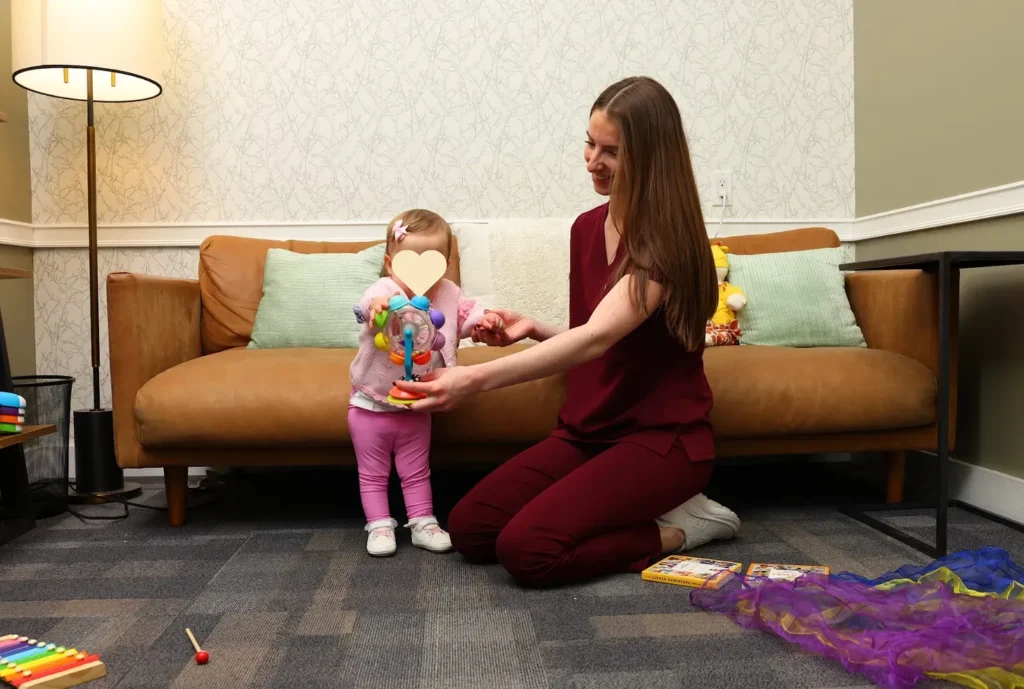
Gross motor: They will begin standing without support, which often looks like briefly letting go of the couch at first. They will start taking a few independent steps and eventually squat down to the floor to pick up a toy and return back to standing without their knees touching the ground (aka deep squat to stand).
Fine motor: They will begin self-feeding with a spoon (expect a mess!) and holding an open cup with two hands (expect spills!). Their play skills will develop to include scribbling with markers, stacking blocks, and turning the pages of books.
Cognitive: Their first words are coming!! Your baby might say “mama” or “dada.” They will also start to understand games like Patty Cake.
The moment it clicks: Walking happens somewhere in this window. Some babies walk at 10 months. Some at 13 months. Both are normal. If your baby isn’t walking by 15ish months and they aren’t making progress towards independent walking, that’s worth exploring with a professional.
Months 16–20: Running (Kind of) and Climbing
Your toddler is on the move!! They’re walking on all kinds of surfaces, they might be running with frequent tumbles, and they’re climbing on everything!
Gross motor: They are walking independently on even and uneven surfaces and they may begin running short distances (with frequent falls). Expect them to be climbing on and off couches or chairs whenever you turn around.
Fine motor: They are using a spoon and fork (still with messes) and are beginning to suck through a straw. They are also developing early self-dressing skills by helping you push their limbs through the holes of a shirt.
Cognitive: Imaginative play is starting to emerge and they begin to follow short, one-step directions. They will also begin to understand danger, like “It’s hot!”
Pro tip: Imaginative play sets are the best at this age – think play kitchen, toy vacuums or mops. They learn by mimicking what you do.
Months 21–24: The Emerging Little Person
By 2 years old, your baby is barely a baby anymore. They’re walking and running independently (with better balance now). They’re climbing with minimal assistance. They can kick a ball and jump with both feet leaving the ground.
Fine motor: Their bimanual (2 handed) coordination improves which is demonstrated by their ability to hold a cup while taking the lid off, stringing large beads, and holding a crayon with their fingers rather than their whole palm.
Cognitive: They are beginning to use 2 word phrases and start answering questions like ‘where’s the dog’ by pointing. They also can likely identify 2 body parts, though this takes practice.
Gross motor: They are walking and running independently and seem to get faster every day! They are likely climbing stairs with a little help or just close supervision. They are starting to pick up playground skills like kicking a ball and jumping.
This is the window: If you’re working on functional skills with your 2-year-old, focus on what they’ll actually use. Have them help carry light objects to the dinner table. Let them assist with putting clothes in drawers. Play along with their imaginative scenarios. That’s where real learning happens.
What Actually Matters: Red Flags vs. Expected Variation
So I’ve given you a ton of milestones. But not every kid hits them on the exact month they “should.” Development isn’t linear. Some kids are late walkers but early talkers. Some are cautious by nature and take their time with physical stuff. Some are fearless and running at 10 months.
Here’s when to actually reach out for an evaluation:
- Your baby is 2 months or more behind on a milestone
- Your baby has been working on the same milestone for more than 4-6 weeks without progress
- You notice asymmetry, like they only reach with one arm, or they favor one side
- Your gut is telling you something is off. Trust your gut. Parents know their kids better than anyone.
Development is variable, but patterns matter. If your 10-month-old isn’t putting weight on their legs at all, that’s worth checking. If your 7-month-old isn’t rolling in either direction, let’s explore it. These conversations shouldn’t cause panic, they should give you information and a plan.
The Toys and Tips That Actually Work
Here are my tried and true toys and tips that I share with every family I work with:
For tummy time (months 3–6):
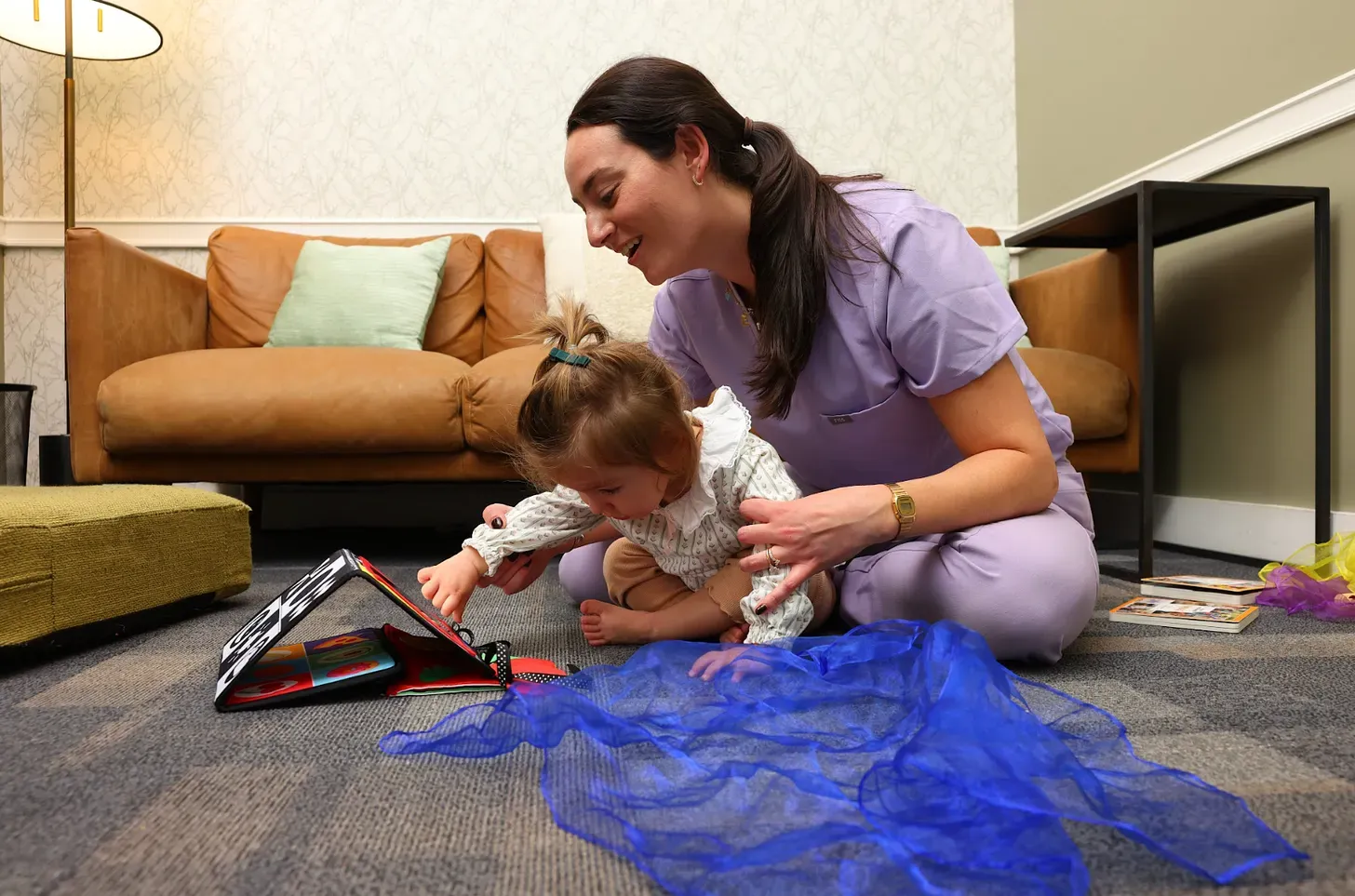
Mirrors, black and white cards, and light-up toys/brightly colored toys. Remember to move toys side to side and up and down to encourage tracking and head movement.
For reaching and grasping (months 5–9):
Pop-up toys, animal sound toys, anything with cause and effect. Hand the toy to your baby in their midline (center of their body) to encourage bilateral awareness.
For crawling and cruising (months 8–12):
Push toys, blocks, Squigz (those suction cup toys that stick to walls and the fridge for easy height adjustments). Place toys off the ground to make your baby stand and reach.
For functional play (months 12–24):
Imaginative play sets, building blocks, and helping with real life chores!
General principle: Modify the environment to challenge your baby just enough. If they’re always supported, they don’t build strength. If they’re frustrated, they shut down. It’s about that sweet spot.
Let’s Connect
Every milestone in this blog is a guideline, not a harsh deadline. But if you ever feel uncertain, if something doesn’t feel right, or if you just want peace of mind? That’s what we’re here for. An in-home PT assessment is exactly what it sounds like…we come to your home, we watch how your baby moves naturally, and we give you real, actionable strategies.
Whether you’re in the thick of tummy time battles or navigating the toddler years, we’re here to help.
📧 Email: info@empowerpt.org
📱 Phone: (201) 591-5253
📱 Instagram: @_empowerpt_
🌐 Website: www.empowerpt.org
Dr. Emily Schlicht, DPT, is the founder of EMpower PT, a concierge in-home pediatric physical therapy practice serving families in NYC. She specializes in motor development and helping families feel confident at every stage.